Image credit: Emma Duncan / Wellcome Sanger Institute.
What does it take to keep more than 20 cancer organoid models thriving? We spoke to Dr Emma Duncan, Technical Specialist at the Wellcome Sanger Institute, who is working on cutting-edge cancer research, collaborating across teams and helping generate data that could lead to future treatments.
Growing tiny versions of human tumours in the lab might sound like science fiction, but organoids are helping researchers answer some of the biggest questions in cancer research. These miniature models are giving scientists new ways to explore how cancers develop, respond to treatment and become resistant to drugs.
Making this research possible takes a team with a wide range of expertise. We caught up with Dr Emma Duncan, Technical Specialist in Dr Mathew Garnett’s group in the Somatic Genomics programme. Emma shares what it is like to work with patient-derived organoids every day, how technical specialists help drive cutting-edge research and what it means to be part of a project that could help shape the future of cancer treatment.
What is your day to day like as a technical specialist?
I'm currently in Dr Mathew Garnett’s team where we're working with over 20 cancer organoid models – 3D miniaturised versions of organs or tissues – which are quite high maintenance. So, a lot of my time is taken up by looking after them. We’re using these patient-derived organoids in large-scale screens where we're treating them with drugs, breaking them down into single cells and then fixing them (preserving cell structure) for downstream sequencing processes. My weeks at the minute are fairly similar, repeating the same process with different organoid models.
The Technical Specialist role itself varies depending on which team you're in. Generally, the role involves leading more on a research project and being more in control of your own work than say, for example, a research assistant.

What is your background in? How did you end up at the Sanger Institute?
I've always been interested in human biology, including how the human body works and what can go wrong with it. My A levels were quite science focussed, including biology and psychology. Following this, I wanted to do something which interested me, so I went to Loughborough University and studied human biology as an undergraduate degree, and then I moved to the University of Nottingham and did a master's degree in molecular diagnostics.
After that I was job searching, and I wanted a research role, so ended up moving down to London. I'm originally from Lincolnshire, so that was quite a big move for me. I went to Queen Mary University and was a research assistant for two and a half years. I was working on a project based on the regulation of cholesterol biosynthesis, which involved quite a lot of cell and molecular biology. We shared our labs with multiple teams, and I ended up doing a PhD at Queen Mary with one of the other teams working on a rare neurodegenerative disease called autosomal recessive spastic ataxia of Charlevoix-Saguenay. At the time, we knew which genetic mutations caused the disease, but it was not clear how these mutations resulted in the neurological changes associated with the condition. So, my PhD was very much focussed on trying to work out what that gene function was and why these mutations caused particular characteristics or phenotypes. I was working with patient cells, doing lots of cell imaging and molecular biology.
When I finished my PhD, I got a postdoc position at the Babraham Institute in Cambridge, so ended up moving up to Saffron Walden from London. That was a three-year postdoc working on a specific kinase signalling pathway and how its deregulation contributes to cancers, which got me more interested in cancer research (which is what I'm working on now). Across my career, I've worked on several different diseases, with different cells and tissue types, which is why I call myself a general cell and molecular biologist.
Once I'd finished my postdoc, it was the COVID-19 pandemic, so I actually interviewed for my role at Sanger online because we couldn't do it face to face. I was looking for more of a translational research role, not just primary academia. So, this role came up within Open Targets, a public-private partnership that aims to prioritise drug targets, which I was really interested in because it was working with industry as well as academia, very much trying to bridge the gap between the two. I got the role and started in September 2020 working in the validation lab, developing and executing methods to validate novel cancer drug targets that had come out of larger Open Targets projects (Project SCORE and ENCORE). The lab had only started up earlier that year, so I was the first member of the team, along with my manager, and we helped set up the lab. I was the oncology lead, and as the team grew, we started working on neurodegeneration and immunology as well.
How did you end up working on organoids?
In 2024, I went on maternity leave and unfortunately during that time the validation lab ceased to exist, so shortly after my return I moved into Dr Mathew Garnett’s team working on a different Open Targets project: The Perturbation Atlas. I started in December 2025, working with patient-derived tumour organoid models. The aim of the project is to create a large novel single-cell dataset of cellular responses following exposure to drugs. We hope to identify drug targets that lead to cancer progression, spread and/or drug resistance. We have around 25 organoid models in culture, most are colorectal cancer, and a few pancreatic cancer, with plans to expand into more tissue types in the future.
For this project, we plate the organoids into 96 well plates and use lab automation to help us apply drugs to these organoids for defined time periods before breaking them down into single cells. The cells are then fixed and, in partnership with Parse Biosciences, shipped for single-cell sequencing.
All the data that we obtain will be shared with partners of the Open Targets consortium, so they can analyse it and select the best candidate drug targets.

Emma Duncan working on organoids. Image credit: Emma Duncan / Wellcome Sanger Institute.
What are the most rewarding and challenging aspects of your job/work?
What I'm doing now requires a lot of teamwork, which is rewarding as we wouldn't be able to do it if we weren't working as a team. It requires a lot of people with different expertise to come together for each aspect of the work. And also, the interaction with industry partners has been fulfilling as well, as you see how your data and what you're doing could have impact in the future.
One of the main challenges of this project is maintaining around 20 organoid models in a healthy state while simultaneously carrying out high-throughput experiments on them over an extended period of time. This requires a lot of organisation and project management, as well as hands on lab time. However, I'm part of a great team within the Garnett group that work well together to ensure this can happen.
What opportunities has the Technician Commitment provided you?
I try to take advantage of the Technician Commitment when I can. I was in the first cohort of The Herschel Programme for Women in Technical Leadership. It's a six-month development programme for women in technical roles, and it's a nationwide initiative, so you take part alongside not only people from Sanger but also others from across the country. There are courses once or twice a month covering various aspects of leading teams and developing professionally.
The programme was really valuable for my career, helping me build new skills. It also gave me a real boost in self-belief, as the programme covers lots of different areas, including building confidence and personal development. Sharing experiences with people from across the country was really helpful too, as it gave me different perspectives. Some people were in roles similar to mine, while others had completely different technical roles, so it was great to learn about their experiences and build a wider professional network.
What advice would you give to others who might be considering a similar career path?
I would say go with what you enjoy doing the most, that’s what I've done so far. Get involved with as much as you can in your place of work, all the opportunities that are available, just get involved and continue to learn new things all the time. I would also say to surround yourself with good people and a good support network. I think having a great team to work with makes all the difference to your role.
What do you like to do in your spare time?
I have an almost two-year-old son who takes up a lot of my time at the moment, so I don't have a huge amount of spare time, but when I do get the chance, I'm a triathlete. I'm a member of a local triathlon club, so I enjoy swimming and cycling the most, with a little bit of running on the side. Before I had my son, I was quite competitive and competed for Great Britain. I competed in Spain and Belgium in 2022 and 2023. Hopefully one day I'll get back to competing again.
I also like travelling by bike. My husband and I recently have come back from our first cycle tour with our toddler in the Moselle Valley in Germany – it's an off-road cycle route along the river. My son was on the seat behind, and he absolutely loved it. We had a great time.

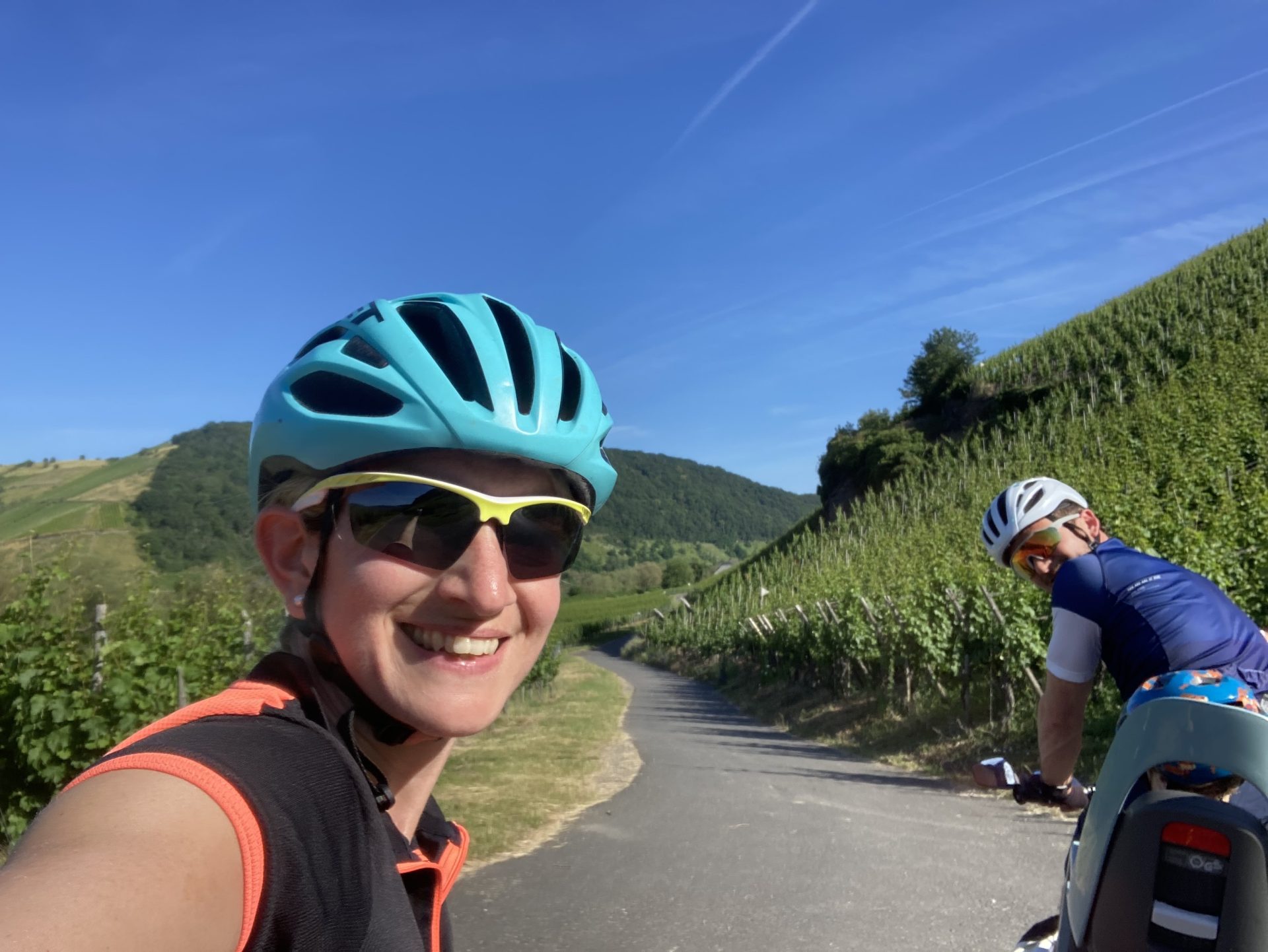

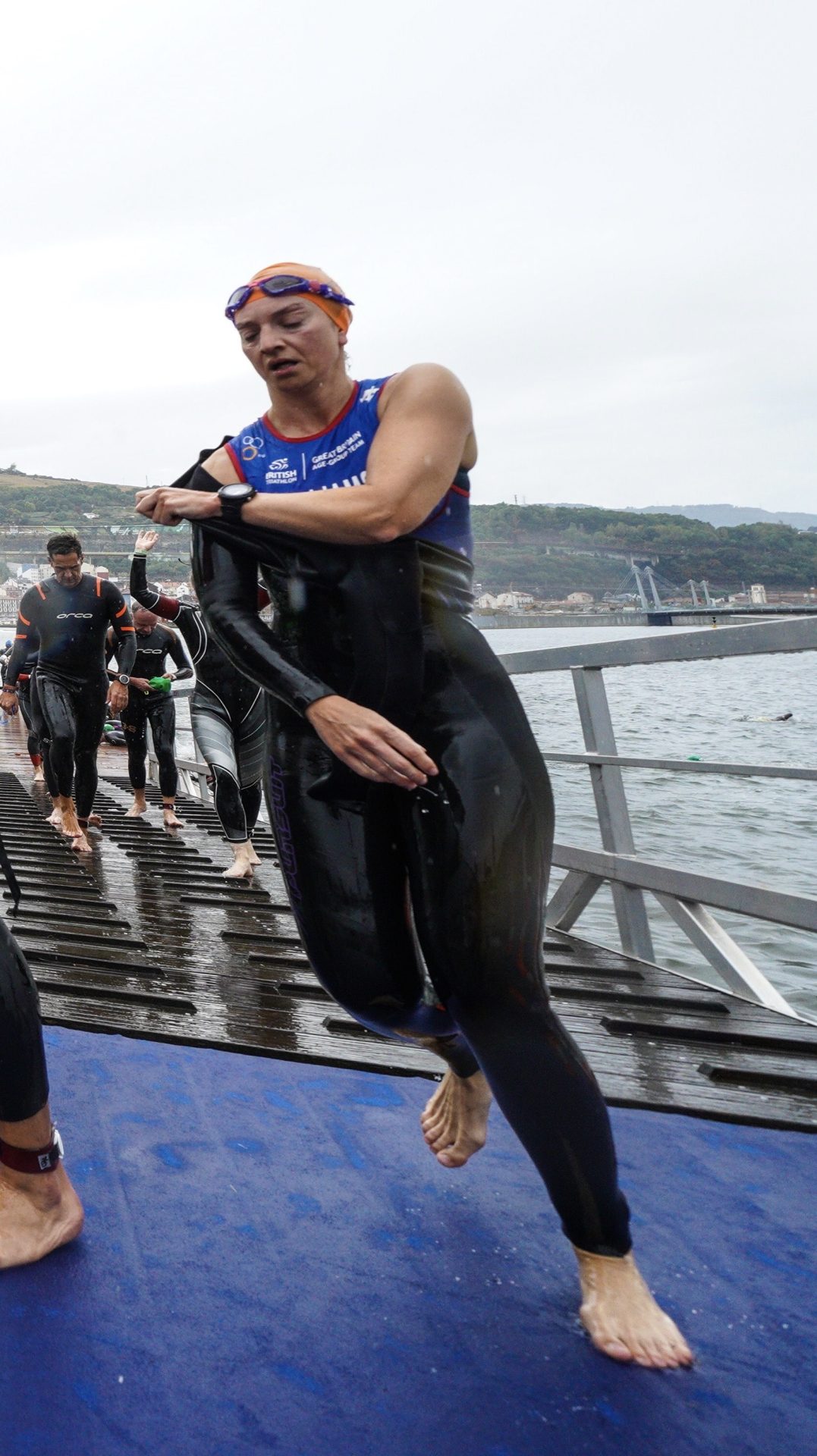
Emma doing what she enjoys - taking part in triathlons, as well as her cycling trip to Germany (top right). Images credit: Emma Duncan / Wellcome Sanger Institute.
What book, film, podcast or show has inspired you recently?
Again, I don't have an awful lot of time at the minute for reading and watching films, but I did recently watch a film called Hidden Figures. It is the true story of the three African American women that were involved in the launch of astronaut John Glenn into orbit. I found it really inspiring how these women overcame many challenges to achieve really great things.