


Image credit: Wellcome Sanger Institute.
Senior Data Scientist, Dr Amir Akbarnejad at the Wellcome Sanger Institute shares what it is like to solve biological puzzles through maths and machine learning, why he enjoys the challenge of problems without easy answers and how collaboration helps him see the science from a different angle.
Biologists are not only born in biology departments – they emerge from physics labs, computer science suites, engineering workshops and in Amir Akbarnejad’s case, the world of mathematics and computational engineering. Stepping into the life sciences from a different field can feel like entering a new ecosystem, yet it is precisely this diversity of training that is helping reshape modern biology.
Now, applying engineering logic and computational tools to unpick the intricate language of cell-cell communication, Amir is learning fundamental biology from colleagues while bringing a powerful new perspective to understanding how cells behave. We caught up with Amir who discussed his latest work and reinforced why the future of biology is not just being built at the bench, but from every corner of science and technology.
What does a typical day in your life as a Senior Data Scientist / Postdoc look like?
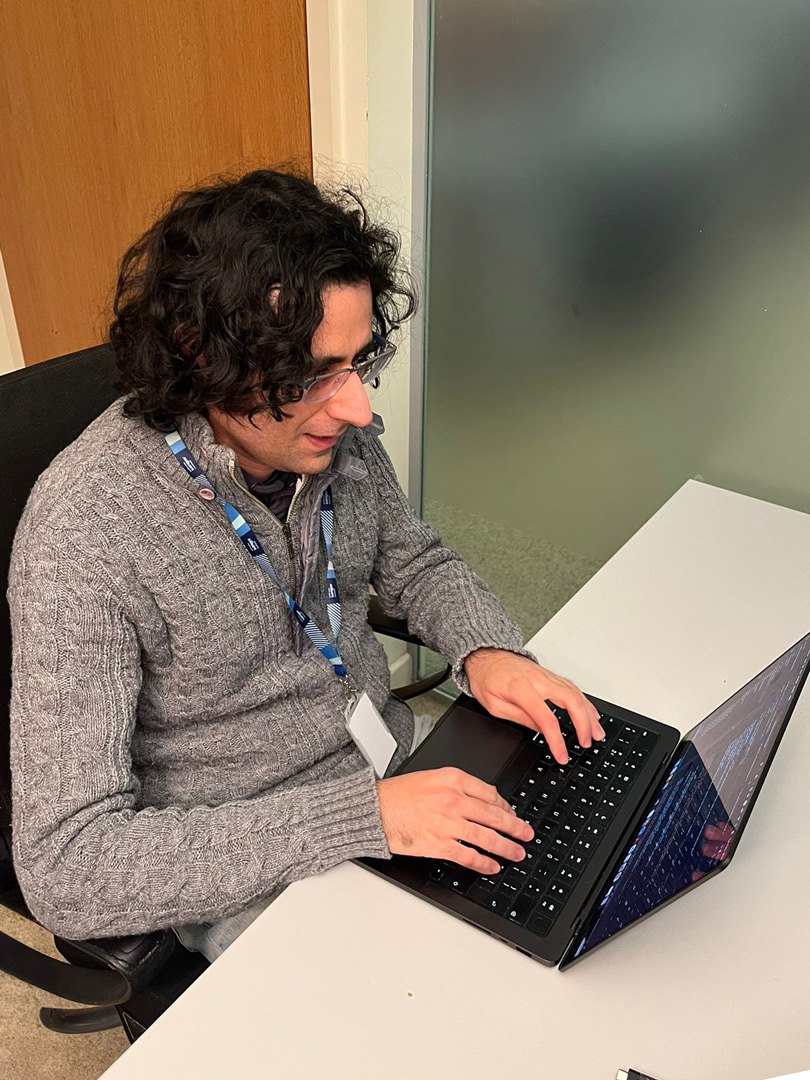
I am working in Dr Mo Lotfollahi’s group in the Cellular Genomics programme and have been at the Institute for two years now. I, like many other colleagues in the lab, have a computational background. For example, I haven’t had any official biological training – I mostly do the computational side, while learning about the biological side along the way. I am involved in developing methods to help biologists discover or analyse biological data. I spend most of my time at my laptop. Once a method is finished or is ready to use, I spend a significant amount of time discussing it with my colleagues, because they're going to end up using the tool, and then we work together to perform the analysis.
“I continuously talk with my colleagues to make sure we exchange knowledge. I really enjoy this because it is the learning model I believe in.”
Dr Amir Akbarnejad,
Senior Data Scientist, Lotfollahi Group, Wellcome Sanger Institute
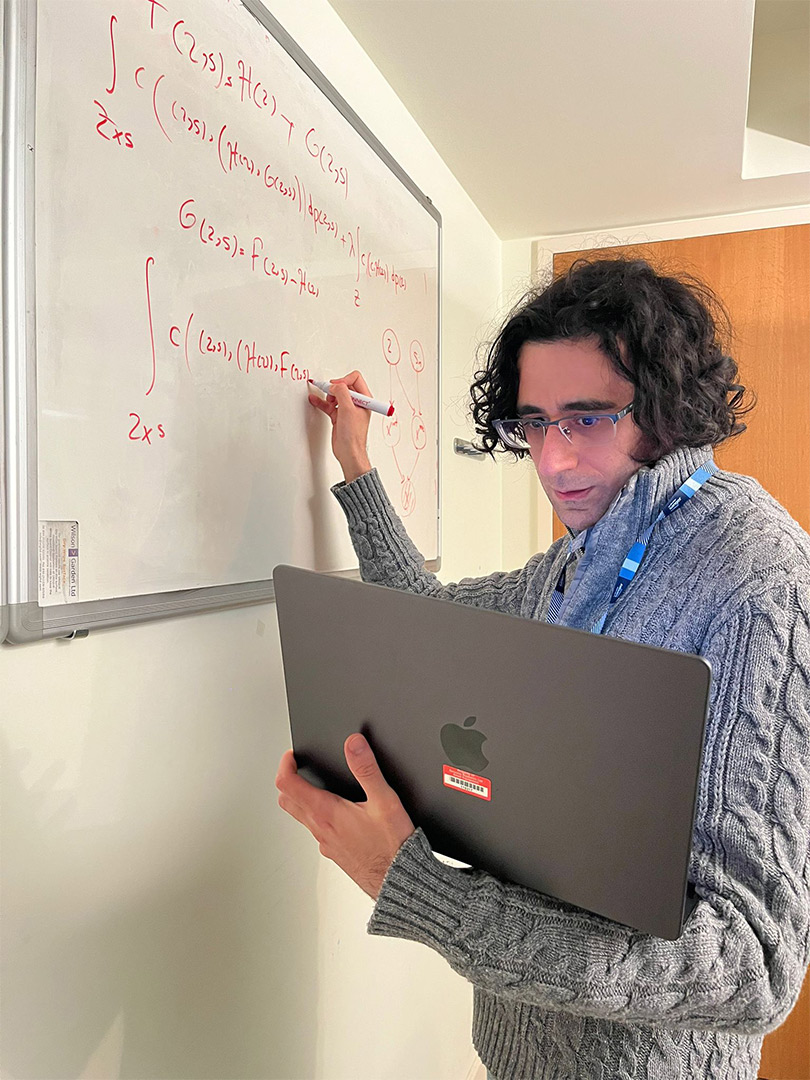
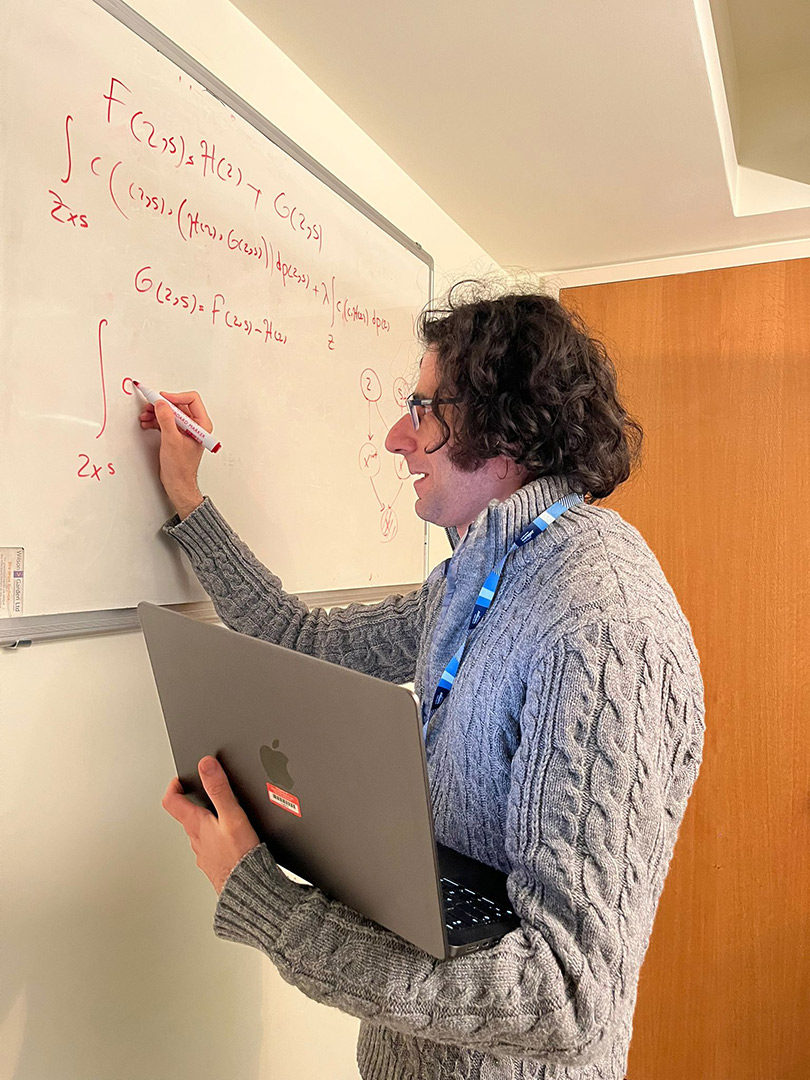
For example, when I worked in Canada at the University of Alberta, my co-supervisor, Dr Gilbert Bigras who is a pathologist, repeatedly invited me to his office to explain how he inspects tissue under the microscope. At first it was hard for me to understand, but over time we built a common understanding. Although this approach takes more time, I think it puts both parties in a better position to think about and attack the research problem together. I have learned a lot of things from my biologist and medical doctor colleagues over the years – and here at Sanger too. I try to do the same thing in return by sharing information they need from the computational side. When I started working on the MintFlow project, I didn’t know the basics of cell-cell communication. My supervisor, Mo, encouraged me to read up on the topic, and my learning was then complemented by discussions and insights from my biologist colleagues.
How did you end up here at the Sanger Institute?
I was born in Tehran, the capital of Iran. During my bachelor’s degree at Sharif University of Technology, I firstly chose pure mathematics because I liked it, but my family and some colleagues recommended that I switch to computer engineering so I could find jobs. So, I switched to computer engineering and then, also completed my master’s there doing artificial intelligence.
After this, I went to Germany to start a PhD but after two years I left that doctorate programme. However, I did gain a lot of experience in processing and analysing graph data – data that represents the connections and relationships between different things. I then switched my PhD and went to the University of Alberta in Edmonton, Canada, working with Dr Gilberta Bigras and Professor Nilanjan Ray, where I graduated after 5 years.
“Changing my bachelor’s degree and PhD were both pivotal moments in my career. I was very apprehensive to take the risks – but it has benefited me greatly.”
Dr Amir Akbarnejad,
Senior Data Scientist, Lotfollahi Group, Wellcome Sanger Institute
My background is in statistical machine learning, but my PhD was half statistical machine learning and half digital pathology for breast cancer. More specifically, I was looking at whether we could use machine learning methods to accurately predict molecular information about breast cancer from histology images. My thesis showed that machine learning can do this remarkably well, even for biomarkers whose relationship with tissue appearance is not yet fully understood, provided it is trained on a large amount of high-quality data.
I really enjoyed Canada; Edmonton had really cold but beautiful winters. I was actually there during the Covid-19 pandemic. One fun memory that I have is that since no one was on campus during the pandemic, when we eventually went back into the office in person, deers had taken over!
Upon finishing my PhD, I was nearly going to move to the Mayo Clinic in Minnesota, to work with Professor Hamid Tizhoosh, who is a pioneer in computational pathology, but for personal reasons that didn't happen. And then I came here to the Sanger Institute. My PhD was about to finish, and I looked up top places to do research and Sanger is one of the best places for computational biology. At the time, Mo was just establishing his group, and we got to know each other. Interestingly, we both have the same alma mater. So far at Sanger, I’ve been working remotely with two other graduates from Sharif University, and they are really bright scientists. Among ourselves, we joke by calling us the La Masia (FC Barcelona's youth academy) products.
RELATED SANGER BLOG
What is spatial transcriptomics?
Ever wondered what your cells are up to in their own neighbourhoods? Spatial transcriptomics is opening a new frontier where space meets gene expression, revealing hidden insights into how tissues function, interact and change in health and disease.

Can you tell us about your current research project?
My main project has been developing a computational method to infer and analyse cell-cell communication, which is important for understanding diseases and, for example, improving cancer immunotherapy. Alongside my colleagues, I’ve been working on a method that specifically infers cell-cell communication from spatial transcriptomics data. Understanding how cells communicate and identifying immunosuppressive genes can help us better understand how tumours evade the immune system and, ultimately, identify potential ways to target cancer and other diseases. The method is called MintFlow - Microenvironment-induced and INtrinsic Transcriptomic FLOWs – and can help separate what a cell is doing on its own, from what it is doing in response to its surroundings.
I think a good example is our mobile phones, the signals that they receive are a mixture of different signals – and there are algorithms to disentangle these signals. For example, when you talk to a family member or friend on the phone, you only hear their voice, not loads of people talking together. MintFlow is basically a similar mathematical model for cell-cell communication and, like with cell phone signals being disentangled, it can also remove noise and pick up the exact signals passed between two cells, instead of an aggregation of what is happening.
Working with a collaborator from Munich, PhD student Sebastian Birk, who is knowledgeable about the biological side of cell-cell communication, we developed the causal modelling elements of MintFlow – that is, methods for understanding how changes in one cell can cause changes in another.
The preprint of our model is currently online and so far, we have received a lot of positive feedback – some experts believe and mention it is a gamechanger in the field. From my knowledge, intrinsic and extrinsic signals can make it hard for biologists to understand the spatial data. Therefore, MintFlow can help biologists make conclusions about how a microenvironment-induced phenotype happens, once they have determined what is intrinsic versus extrinsic. Another application is in organoids – 3D, miniature, self-organising structures that mimic a real organ. Researchers can use MintFlow to know how cells will differentiate when a specific combination of cell types are put together in the dish.

What has it been like moving around the world throughout your career?
I think it has been hard at times. I migrated three times in seven years. But I think it has been a learning opportunity for me to get to know different scientists and learn different mindsets.
Learning to navigate new cultures has been both challenging and enjoyable. British culture in particular has fascinated me – the communication style is remarkably indirect, often relying on subtle cues and polite courtesies.
What advice would you give to other people who are thinking of pursuing a similar career to you?
From my side, I think something that I've been trying to adopt throughout my career is to not get blinded by what I'm doing and to not lose the big picture. Because when you pick a specific field, it's really easy to lose the big picture. For example, I try to be open to a lot of different tools and approaches.
“I think sometimes people just stick to what their background is in – but I try not to be that person. I like to learn and try new things.”
Dr Amir Akbarnejad,
Senior Data Scientist, Lotfollahi Group, Wellcome Sanger Institute
If you were not a data scientist, what would you be?
From childhood, I wanted to become a musician. I liked the piano and violin. I didn’t become a professional, but I still play the piano – I bought one in Germany, and then I sold it, and then I bought one in Canada, and then sold that. Now I have one in Cambridge. I am an amateur, but it is a passion from my childhood. When I was a teenager, I was very inspired by classical music, for example, Wolfgang Amadeus Mozart and Frédéric Chopin. But now, I am inspired by hip hop as well.
What do you like to do in your spare time?
I like to go on very long walks, like five to six hours. I don’t take taxis, so I just go to a city or village and walk home. I also like documentaries and true crime investigations.
What book, film or podcast has inspired you recently?
A university professor in Canada whom I worked with and who was very kind to me recommended that I listen to Alan Watts podcast, which I really enjoyed and would recommend to others too.


