


Image credit: Carmen Denman Hume / Wellcome Sanger Institute.
Cecilia Kyany’a studies the fascinating microbiology of the airway microbiome, especially in people living with cystic fibrosis. As part of her PhD research, Cecilia is uncovering the hidden microbial worlds that shape this complex condition.
Cecilia Kyany’a is a PhD student in Josie Bryant’s Group at the Wellcome Sanger Institute, where she uses genomics to study how microbes and human cells interact in the lungs of people with chronic lung disease, such as cystic fibrosis.
Originally from Kenya, Cecilia began her research career as a clinical scientist studying methicillin-resistant Staphylococcus aureus(MRSA) infections in Nairobi. It was during this time, at the Kenya Medical Research Institute (KEMRI), that she attended a Sanger-led microbiome training course facilitated by Dr Ewan Harrison – an experience that would shape her next steps.
We spoke to Cecilia about her interests outside of work, her journey to the Sanger Institute, spatial transcriptomics, and learned a lot about the stealthy microbes that cause chronic lung disease.
What type of laboratory work were you doing before you applied to the Sanger Institute?
I worked as a research scientist in what was at the time, the first national multicentre antimicrobial resistance (AMR) surveillance program in Kenya, at the Kenya Medical Research Institute (KEMRI) in Nairobi. The team I was a part of conducted microbial genomics analysis to understand the population diversity as well current and emerging AMR trends of the World Health Organisation (WHO) and the U.S.A. Center for Disease Control (CDC) priority bacterial pathogens.
While at KEMRI I enjoyed training and mentoring the visiting scientists and students. It feels very rewarding when a mentee is eventually able to confidently run a polymerase chain reaction (PCR) by themselves or or perform other laboratory tests independently. One of my favourite things was when we provided outbreak support to county hospitals or supported AMR testing for difficult to treat infections.

Members of Dr Lillian Musila's lab at KEMRI in 2021From left to right: Fred Tiria, Martin Georges, Dr Lillian Musila, Erick Odoyo, Cecilia Kyany'a. Image credit: Cecilia Kyany'a.
Most government microbiology labs have limited testing. So, being able to support when needed in critical cases gave the doctors more drug options to try, and the patients a fighting chance. Our group would hang out after work on a Friday, which was very nice too.
What motivated you to apply to a PhD at the Sanger Institute?
After attending the Sanger-led microbiome course facilitated by Group Leader Dr Ewan Harrison, my eyes were opened to what the Sanger Institute had to offer. The Institute is a world-class place to study genomics at a large scale and apply new tools to important biological questions. By the end of the course, I felt really inspired to pursue a PhD somewhere that would value the laboratory skills I had already developed, while also giving me the opportunity to train in new areas like bioinformatics.
While I was preparing my application to the Sanger Institute, Ewan provided support and advice which really encouraged me. I submitted my application and was really pleased to be accepted onto the PhD fellowship and to join Group Leader Dr Josie Bryant’s team in the Parasites and Microbes programme here at Sanger.
What is your PhD research project about?
I have always been fascinated by the dual nature of microbes – their ability to both support health and cause disease. In cystic fibrosis, a rare genetic condition that causes breathing and digestion difficulties, chronic lung infections are a major challenge for patients. By studying how microbes behave in the lungs of a person with cystic fibrosis, we can help improve our understanding of these infections and maybe reveal new treatment options.
For my PhD, I am studying how pathogens and host cells interact in the lung during long-term infection. I use a combination of spatial transcriptomics, light-field and fluorescent imaging, and DNA and RNA sequencing to explore these relationships in more detail.

Cecilia looks down a microscope to assess a sample preserved on a slide. In her pink slide box there are dozens of samples yet to process. Image credit: Carmen Denman Hume / Wellcome Sanger Institute.
My work focusses on a few key questions: where do pathogens persist during chronic infection? Do co-infecting microbes occupy the same spaces in airway tissues? And how do host cells switch genes on and off in response to the microbes they encounter? I hope my work towards answering these big research questions will contribute to improved treatments for people living with long-term lung conditions.
What techniques or methods are you excited to be using?
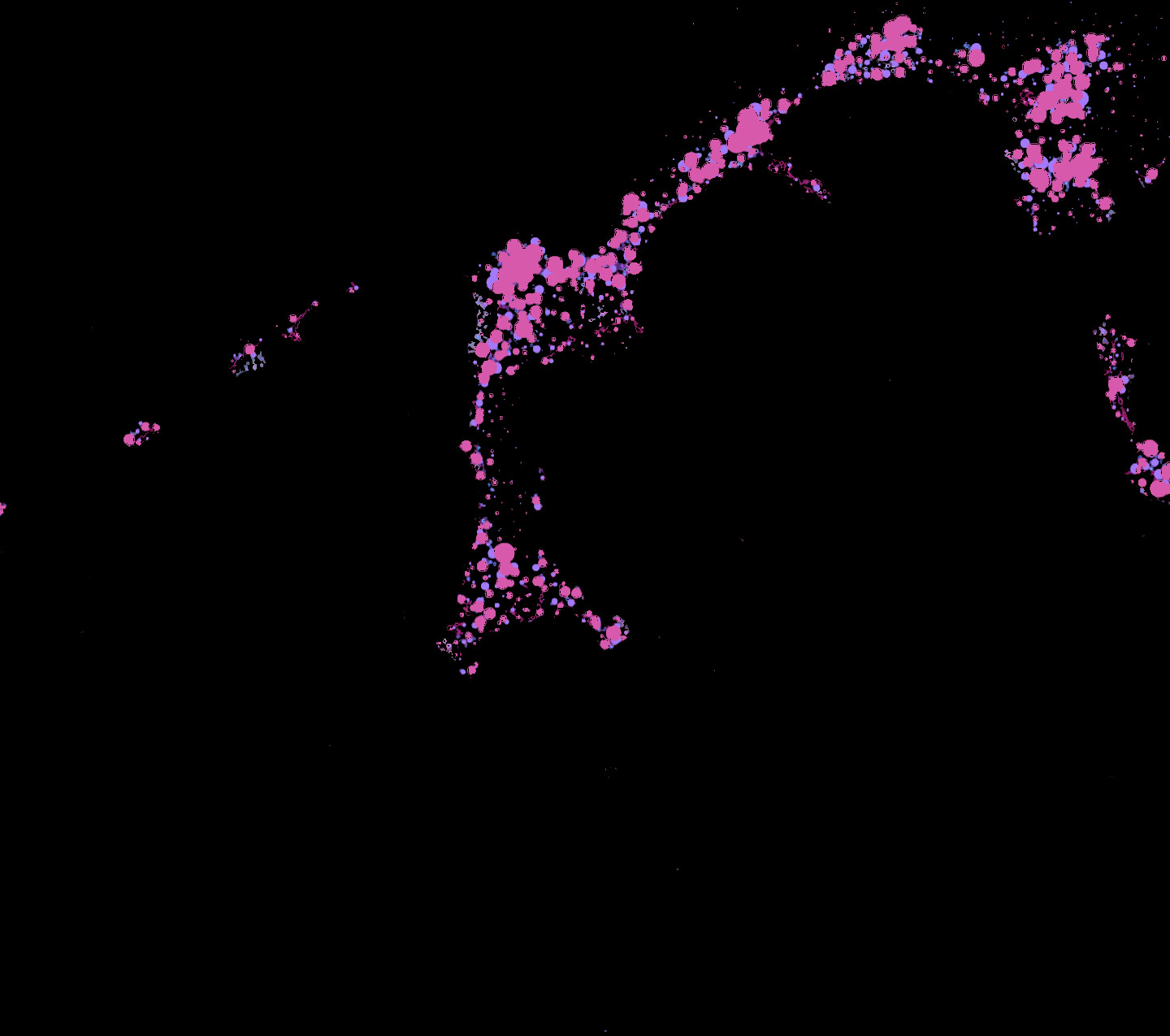
One of the most exciting techniques I am using is spatial transcriptomics. It is an approach that allows you to see not just which genes are active, but where in the tissue that gene activity is happening. This is useful information that may help us better understand chronic airway infections.
When studying tissues sampled from the airways of people with cystic fibrosis, that spatial context is especially important. Josie's Group and the Spatial team are developing bacterial probe panels that can help us pinpoint where bacteria are located in patient lung tissue and explore how they sit alongside host cells during a chronic infection. This means we can look directly at host-pathogen interactions in real patient tissue, rather than relying only on what we see from experimental systems.

When we combine spatial transcriptomics with other genomic approaches, we can also start to see how pathogens adapt over the course of infection and how the surrounding tissue responds. The Sanger Institute’s broader spatial work, including lung atlasing, has shown how combining spatial data with other transcriptomic methods can reveal cell types, tissue organisation, and communication within the lung in finer detail. For me, that makes this a very exciting area to be part of, because it is opening up new ways to understand chronic lung diseases such as cystic fibrosis.

What do you enjoy in your spare time when not peering down a microscope?
I like many many things. I pick and choose depending on what kind of rest I'm needing. For instance, when I need to switch off my brain I watch Goggglebox or true crime documentaries. I like to go on walks, even better if there is a pub at the end of the walk or along the path. When I'm feeling not too tired, I like to take the train or bus to a town I haven't been before and just walk around to experience the town.
Often, I pick a destination based on a book I've read or things we studied as teenagers, like the Greenwich Meridian or the shipping port cities around the UK that were difficult to envision. I like to learn about the history of the places I visit.
I enjoy live performance. We went to a Panto at Christmas. In my first year we went to see a murder mystery in Hinxton Hall - that was a first time experience I really enjoyed. We also went to see a Drag show in Brighton....that was epic! I would say I’m generally curious and up for trying something new!
What do you miss most from home?
Goat! Grilled goat and traditional vegetables are so delicious. And of course I miss my family. I miss hanging out with my siblings and my friends…and mangoes. Kenya has a great climate for growing mangoes, and they are utterly delicious.
Do you have any words of advice for someone considering applying for a PhD at the Sanger Institute?
Be open to learning new skills and stepping outside your comfort zone. For me, that meant moving far from my home and leaving the laboratory (sometimes!) to develop my computational skills.
The Sanger Institute is a very collaborative and supportive environment, and there are lots of opportunities to learn from others. I would also encourage people to seek out advice and mentorship early on, even during the application process. This made a big difference for me.


