


Image credit: Shelly-Ann Coutts.
What do robots, genomics and a lot of very precise pipetting have in common? At the Wellcome Sanger Institute, they are all part of a normal day’s work for Shelly-Ann Coutts, Advanced Laboratory Automation Specialist, who helps keep the science moving by automating tasks within the lab.
Research often involves scientists doing the same careful task hundreds, sometimes thousands, of times. That is where automation comes in. By building instruments and software that allow machines to carry out these repetitive steps quickly and precisely, labs can process more samples, generate more data and give scientists more time to do the fun stuff.
For Shelly-Ann Coutts, automation caught her eye straight away. It is a space where she can solve problems, support others and even indulge her love of Greek mythology by naming the lab’s instruments after legendary figures. In our latest blog, Shelly shares her journey to the Sanger Institute, her enthusiasm for automation and why great science pairs well with a love of fine dining.
What is day-to-day like as an Advanced Laboratory Automation Specialist?
As I imagine most people tell you, it is different day-to-day. It usually depends on the projects that I'm working on and the stage of the projects too. Sometimes a project will mean that I need to be at my desk the entire day working on paperwork or developing methods on my laptop for the automation, or sometimes I might be in the lab all week, nonstop doing tests and training. But most of the time it's a mix of both.
I recently got promoted – I was previously Lab Automation Specialist, and I was mainly focussed on assisting with the delivery of projects, whereas my new role as Advanced Lab Automation Specialist will involve me leading on those projects instead. Fortunately, my team has been very supportive in helping me step up into this role, especially in terms of developing my skills in leadership and communication.
What is your background in?
My working career has been entirely at Sanger. I first learned about Sanger when I was doing my AS levels, and my biology teacher, who was teaching us about DNA, mentioned that she had worked here on the Human Genome Project. I thought this was really cool. Unfortunately, at the time, I didn’t do particularly well in my exams for personal reasons. But I redid Year 12 and did a Level 3 BTEC instead at a different college in Cambridge where we did these things called Challenge Projects. The college partnered with neighbouring institutes and businesses, and they would come in and do a project for a term with the students.
We did a project which was very similar to the Barcoding for Beginners project that Wellcome Connecting Science runs. I went to the Botanical Gardens with a group, and we took samples of some of the plants. We extracted the DNA, ran the PCR and gels in the college lab, and then sent the successful samples off for Sanger sequencing. Afterwards, we looked at the data and assembled a small DNA sequence from it. That sequence is now on the European Nucleotide Archive, and it has my name on it. During the project, we also got to visit Sanger, and I went into the Ogilvie building. When I saw it, I thought it was really cool, so it is quite surreal for me now because this is where I am based.

From this project at school, I knew I was interested in DNA; however, I thought for university I would maybe try to expand my horizons. I ended up going to Bournemouth University and studied forensic biology, which, now that I think about, was actually more niche. I was always interested in the fact that you could find DNA and bits of evidence, and then link that back to solve crimes. At the time, I did love Sherlock and NCIS; I think they were the things that got me interested initially. But there was also a genuine interest from college. It is funny because when I got to my third year, we ended up doing a module on DNA profiling – a technique used to identify an individual from a sample – and I discovered I didn't like it at all, which was great for me to find out!
How did you end up here at the Sanger Institute?
In my third year, the COVID-19 pandemic had started so when I came back home from university in July 2020, the COVID-19 Genomics Initiative at the Sanger Institute was just getting off the ground. This project was the Sanger Institute’s primary contribution to the COVID-19 Genomics UK (COG-UK) consortium, which sequenced SARS-CoV-2 genomes at scale. I was hired in November into this team as a research assistant, and that's when I first came into contact with automation. Before I'd even finished university, I'd been looking at the Sanger website for jobs and I'd applied for loads. I didn’t know the difference between a lot of the roles, but I just knew I wanted to work here.
Before I'd even finished university, I'd been looking at the Sanger website for jobs... I just knew I wanted to work here.
What was your experience like working on the COVID-19 Genomics Initiative?
I was one of the first eight people that got brought into the project to turn it into a high-throughput pipeline. On this project I was working in sample management, which is now called sample preparation within Sequencing Operations. My role involved cherry-picking samples – selecting specific ones from a source plate and transferring them to a destination plate – so they could go through library preparation, which gets the DNA ready for sequencing. During the pandemic, the samples we received had already been processed by the lighthouse labs – high-throughput facilities for testing COVID-19 samples – to determine whether they were positive or negative. We were sent the remaining material to sequence the genomes and track variants across the country. Cherry-picking was the first step in our workflow.
Video explaining how the Sanger Institute helped to deliver the majority of the UK's COVID-19 DNA sequencing. Video credit: Wellcome Sanger Institute.
Cherry-picking was all automated, so in my first job here, I realised that I really enjoyed automation. I was working on the Beckman Coulter Biomek i5 liquid handlers, and I ended up becoming a power user.
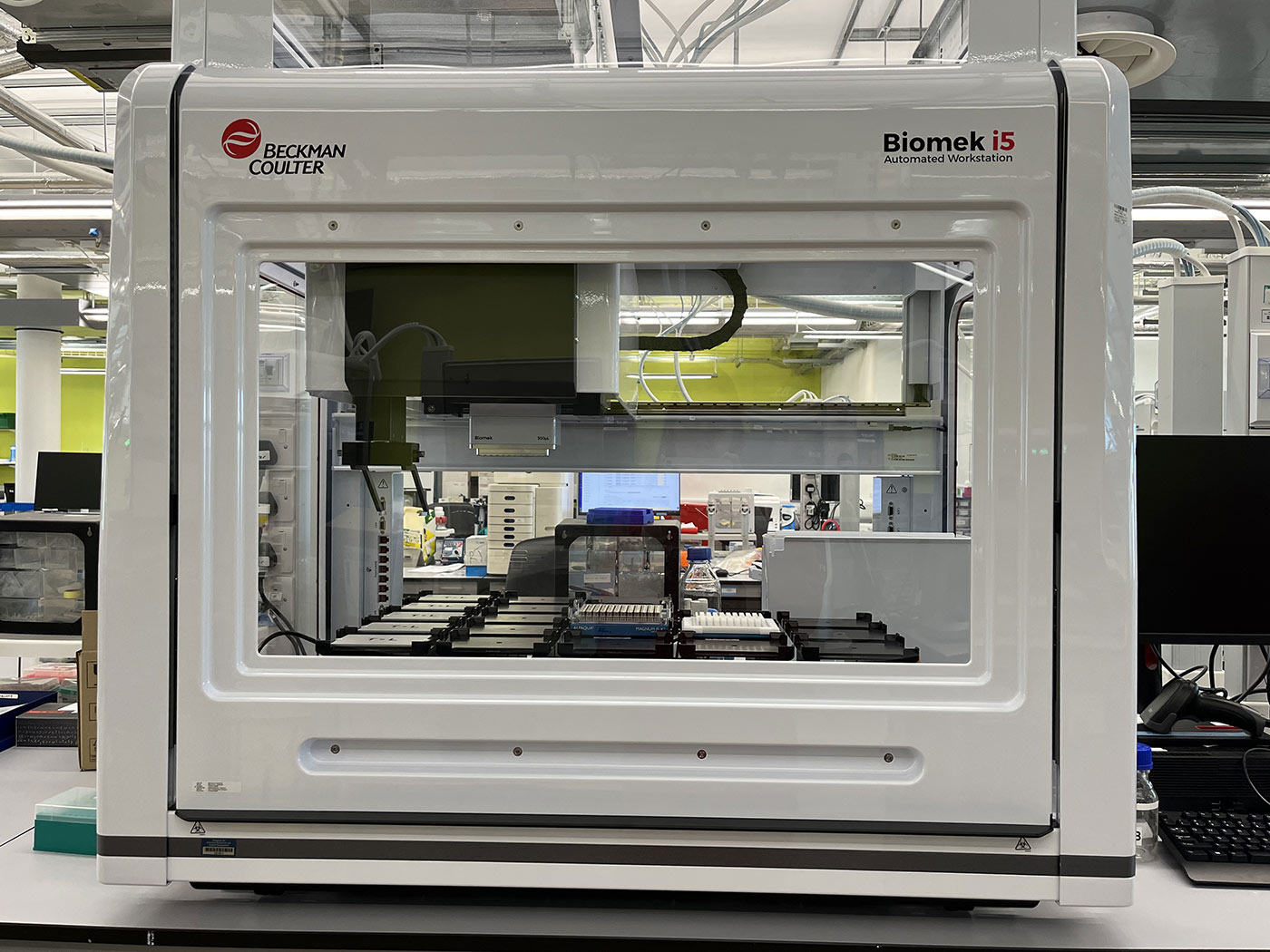
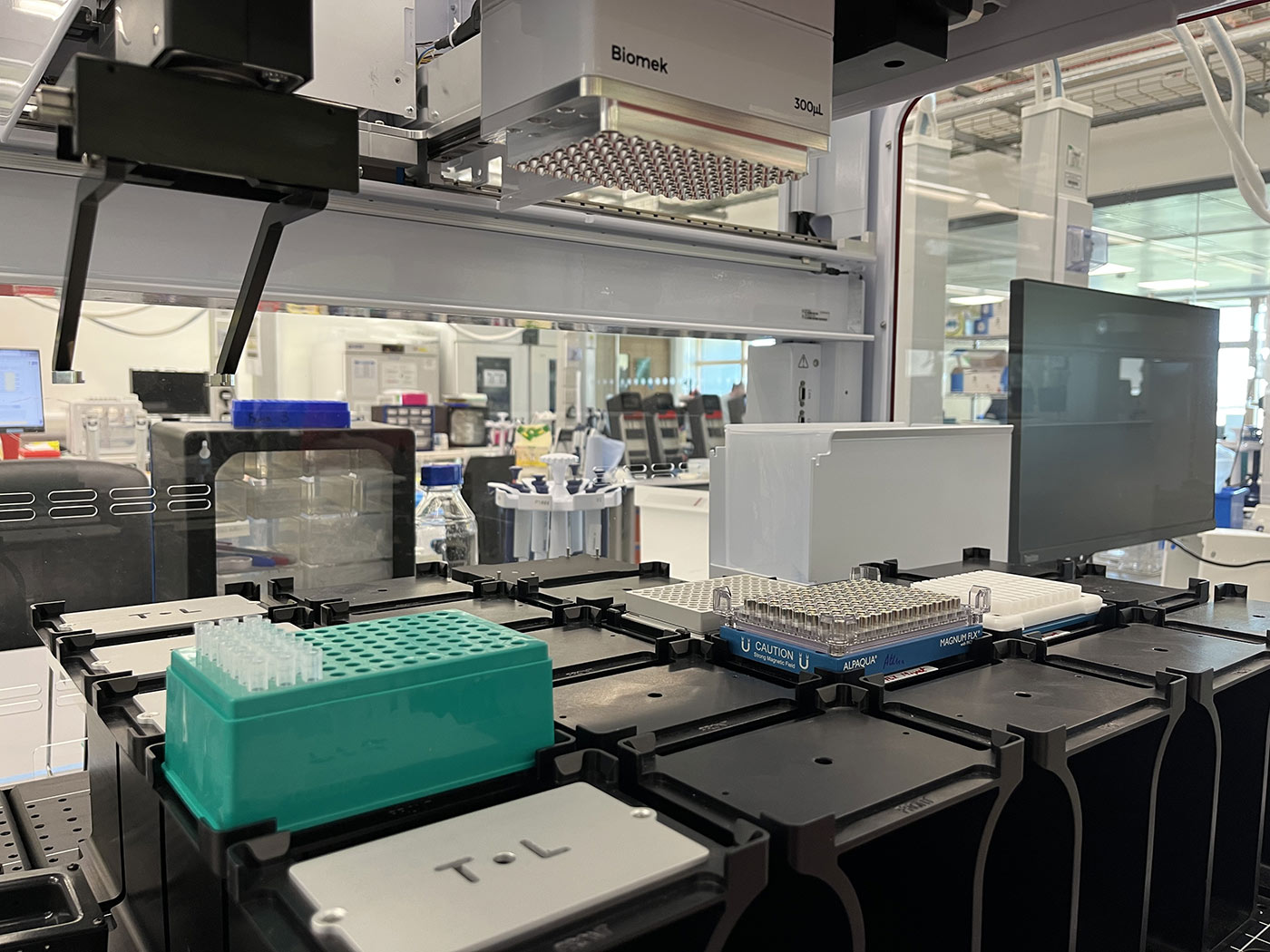
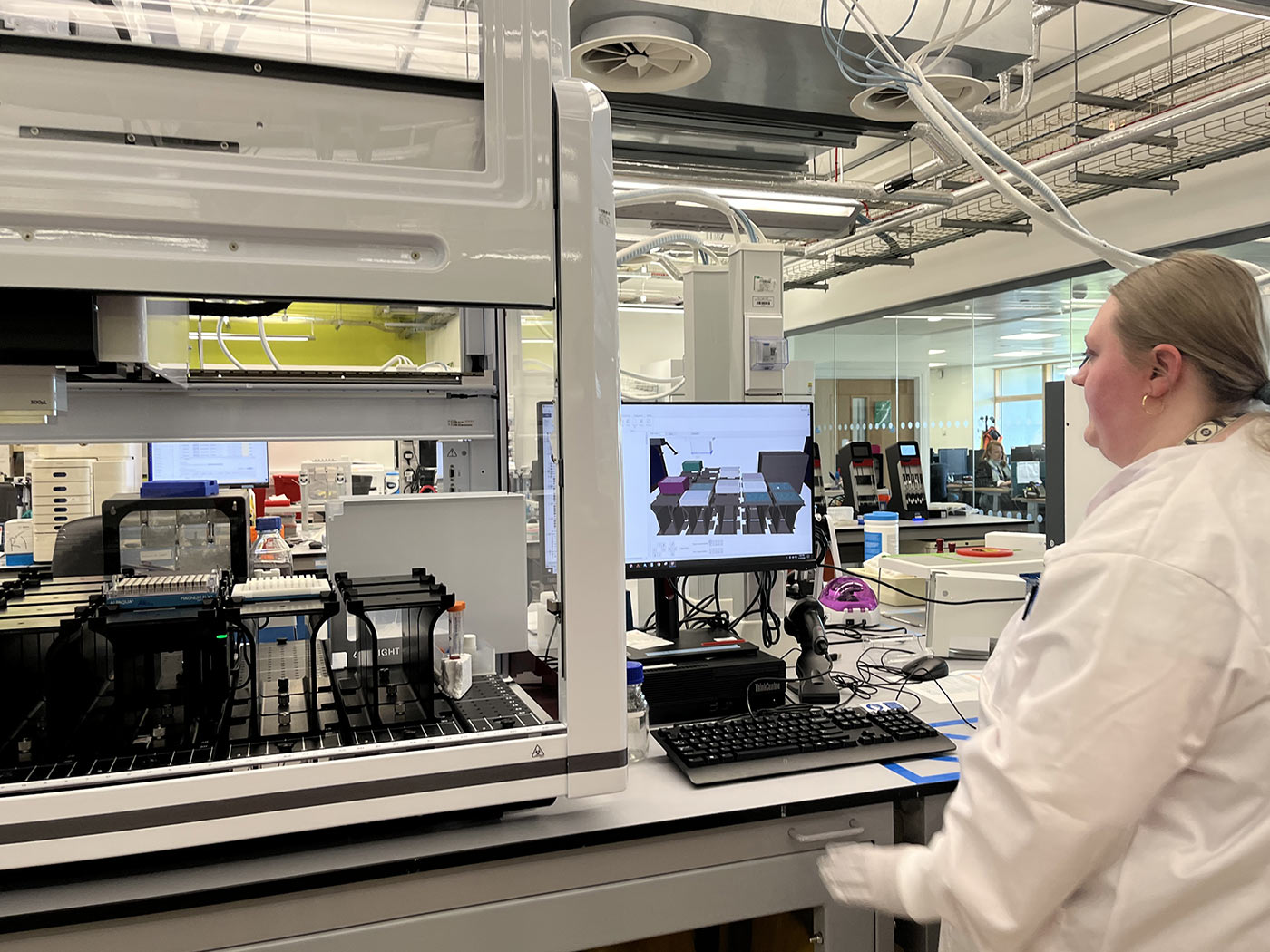

Shelly-Ann working with the Beckman Coulter Biomek i5 liquid handling robot. Images credit: Shannon Gunn / Wellcome Sanger Institute.
In my role, I mainly ensured the robot was set up correctly, with plates in the right positions so it could pick the correct samples. Within six months, as the team expanded, I was promoted to Advanced Research Assistant – an uncommon trajectory that I’m proud of.
Working during the pandemic was intense; at peak, we processed 72,000 samples a week and produced 100 cherry-picked plates daily, including weekends. Despite the pressure, I built lasting friendships and gained hands-on experience with R&D validation and troubleshooting, which deepened my interest in automation and method development.
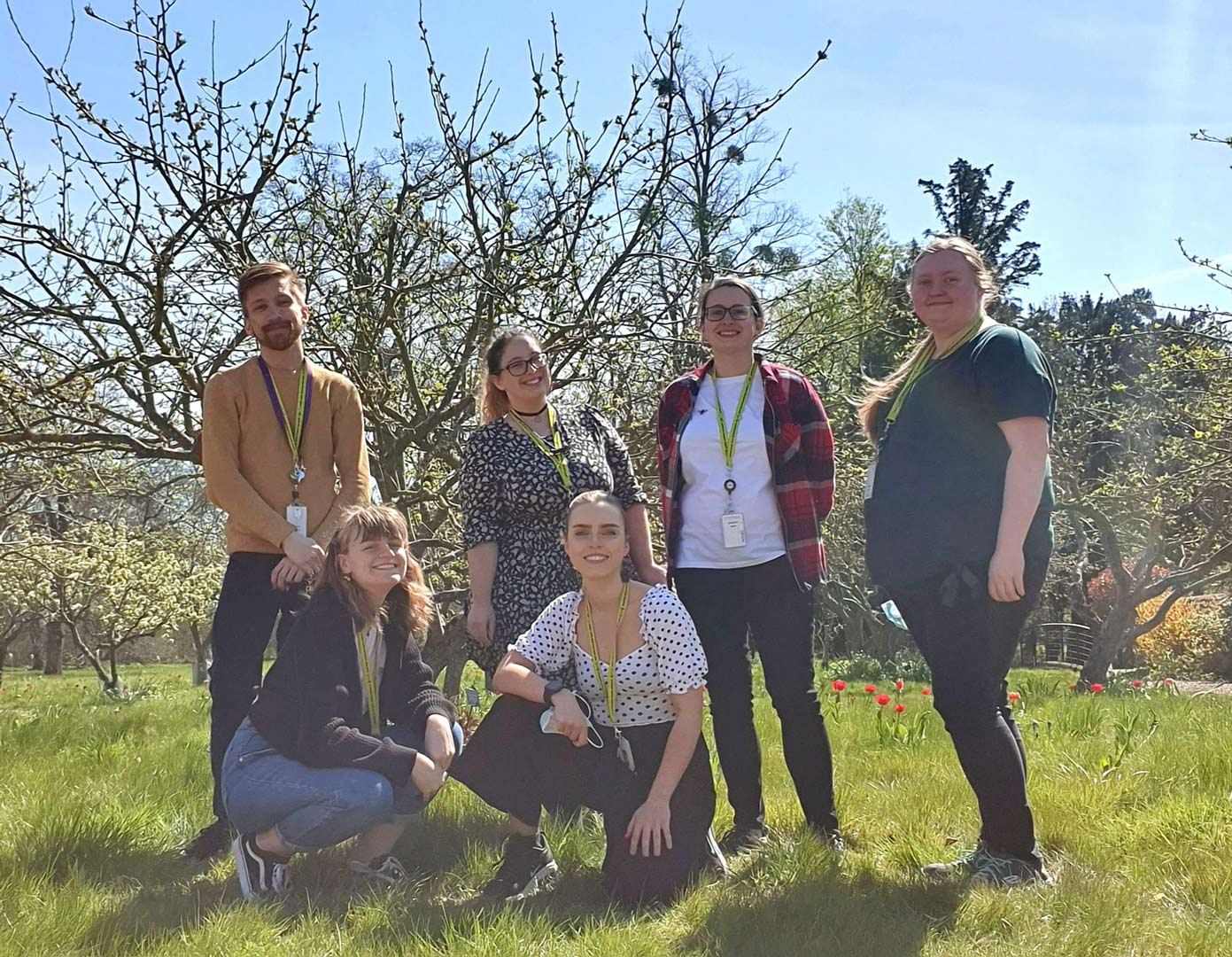
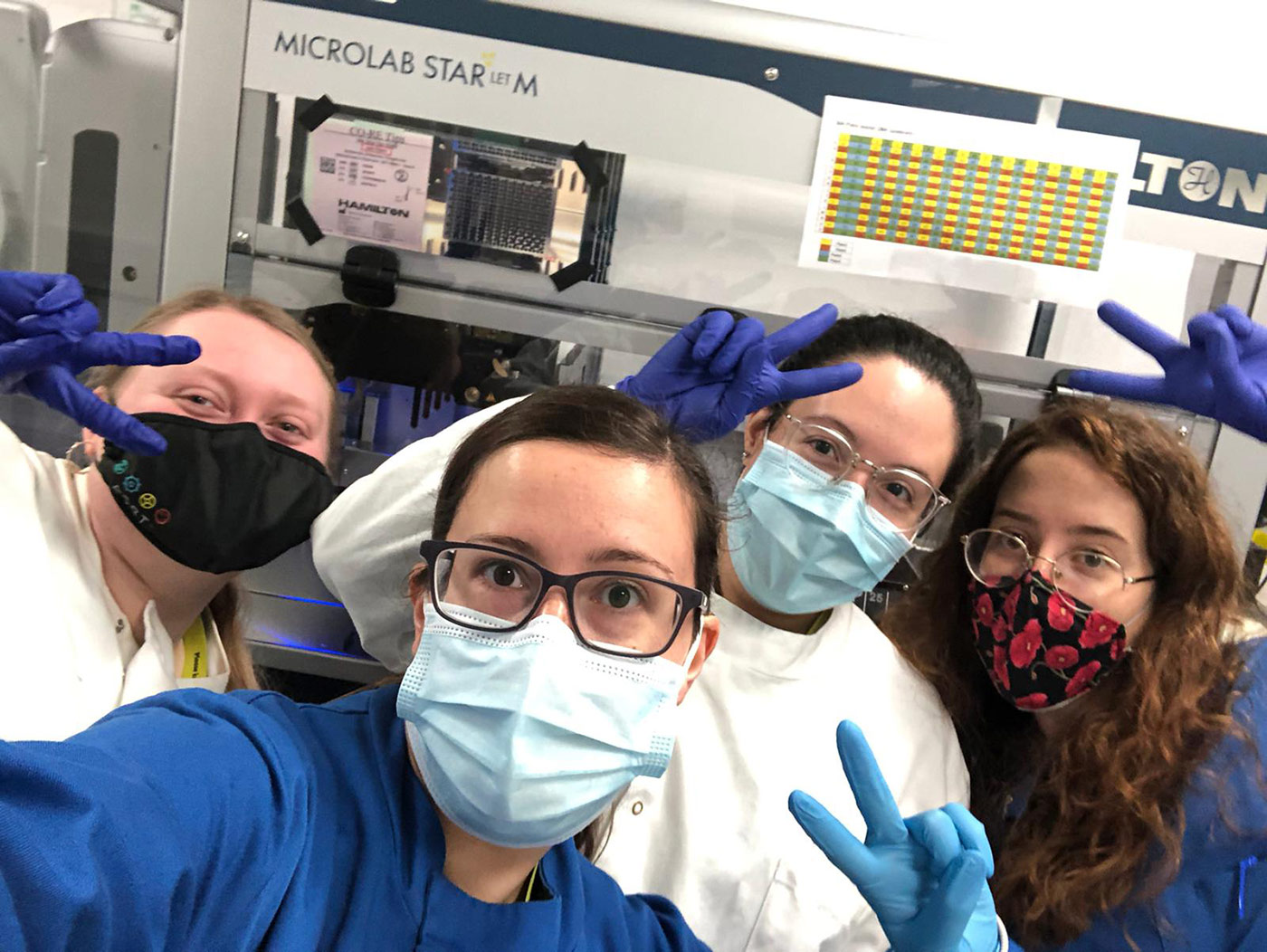
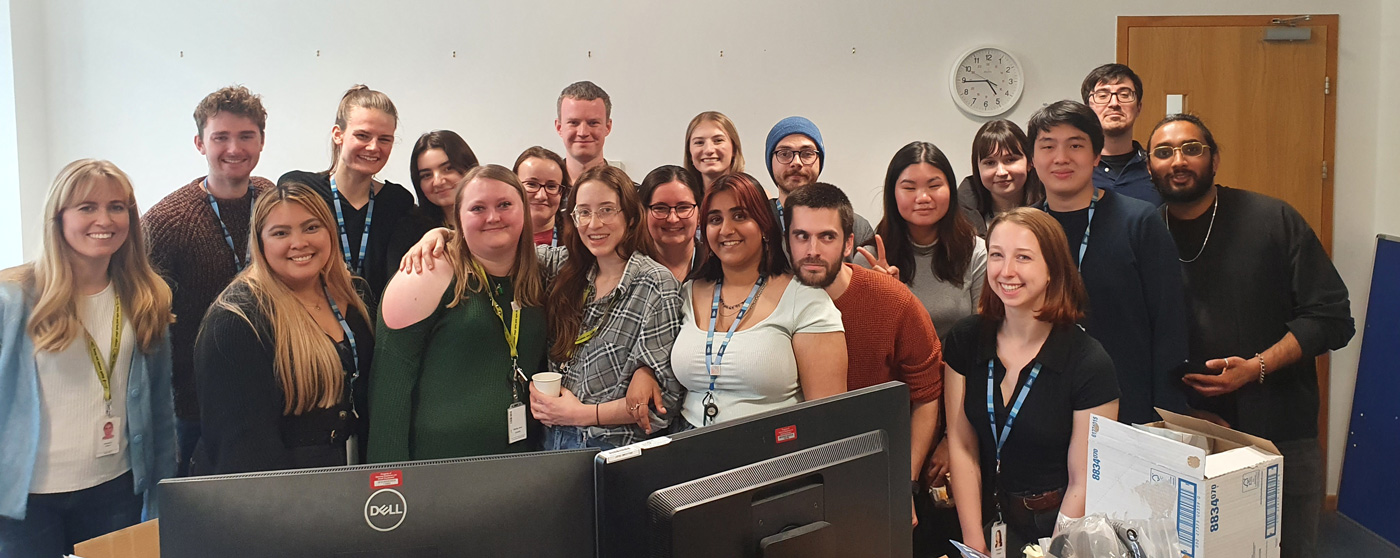
Being part of the COVID-19 Genomics Initiative. Images credit: Shelly-Ann Coutts.
What role did you move into after the COVID-19 Genomics Initiative finished?
I then moved into the Long Read Sequencing team to do DNA extractions for the Tree of Life programme, which involved isolating DNA from samples so it could be sequenced. When I first joined, the long-read workflow was almost entirely manual and the team didn’t yet have their own automation equipment, which was quite different from what I was used to. Within my first couple of weeks, I was already suggesting ways to automate parts of the process and identifying devices that could help.
For example, I worked with the R&D team to help introduce automated DNA quantification – using instruments to automatically measure DNA concentration – into the extractions team. Because we were processing plates of around 48 to 64 samples at a time, and sometimes more than one batch a week, doing that manually just wasn’t sustainable. So, we adapted the automated workflow that Scientific Operations were already using and implemented it into the extractions team. I then helped train other members of the team to use it, which I really enjoyed.
I spent just over a year in the extractions team, and I’m grateful that my manager at the time – Hermione Blomfield-Smith – and the Head of Long Read Sequencing – Emma Gray – really supported my career goals. They always made sure I was involved whenever automation opportunities arose. In my own time, I kept practicing method writing, knowing that’s where I ultimately wanted to be.
When a role opened in the automation team, Hermione encouraged me to go for it. I’ve been lucky at Sanger to have such supportive managers – and, as my ‘I heart automation’ t-shirt made clear, my passion for automation is no secret. A friend even made a funny meme of me pleading to join the team!
How does automation work?
At its core, our automation uses liquid handling robots to move precise volumes of liquid from one place to another, following programmed instructions. These systems use air- or water-driven mechanisms and can handle anything from 8 to 384 tips at a time, depending on the setup. We use a mix of instruments from different vendors, because each one offers unique features. That flexibility allows us to design bespoke workflows, whether through the hardware itself or how we program each method.
Programming a method is largely drag-and-drop. You set up the instrument, add your plates and tips, and define each step of the process. You can also fine-tune how liquids are handled, for example, adjusting speed or introducing air gaps during aspiration. Some systems allow for more advanced control. For example, I developed a pipetting template – a set of instructions that defines how the robotic pipette moves – where I programmed the tip to enter at a specific angle and move up and down to ensure it captured the full mixture.
What projects are you working on?
Most of my current work is still focussed on long read because I have experience working with that material. When I started in the team, there was a long-read automation project, but no automation had been brought in yet. I contributed by talking to vendors and selecting which automation instruments we were going to start using.
There are a couple of approaches that you can take to automation. Quite a lot of places go for the big robot that does everything, and you put the samples on, you leave it for like six hours, and you take the samples off, and it's done. One of the disadvantages with that approach is that sometimes during certain steps, the robot is just idle and it's not doing anything. So, to increase the utilisation of the equipment, we wanted to move to what we call a modular approach, which involved finding the best piece of kit that worked for each step. Now, one library preparation uses five different automated systems. We started by automating PacBio’s SMRTbell Long-Read Prep Kit 3.0 (SPK3), which the Long Read Sequencing team uses to turn DNA samples into libraries ready for sequencing. Each library prep involves multiple precise steps. Before automation, a single person could process only about 24 samples per batch, sometimes running a couple of batches a week – which meant a lot of repetitive pipetting. By automating the workflow, we were able to scale up the process, reduce manual work and handle more samples efficiently.
I’m currently working on pipette tip shearing, a method to break DNA into smaller pieces for high-quality sequencing. Traditionally, the Long-Read Sequencing team use a Megaruptor, which shears DNA with syringes, but this is costly and only handles eight samples at a time. We’re now testing Hamilton’s method, which uses pipette tips on the automation deck to shear DNA directly in a 96-well plate. This saves time and money by using existing tools. The shearing step works well, but the next challenge is purifying the DNA and removing unwanted fragments at larger volumes. I’m currently validating that process.
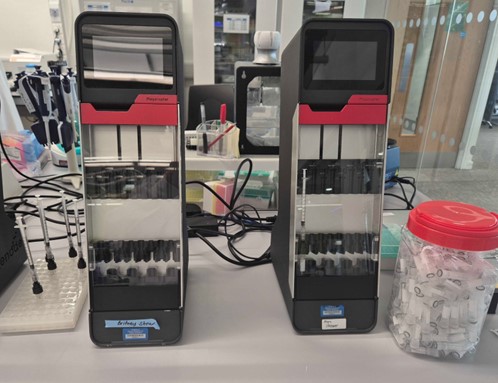
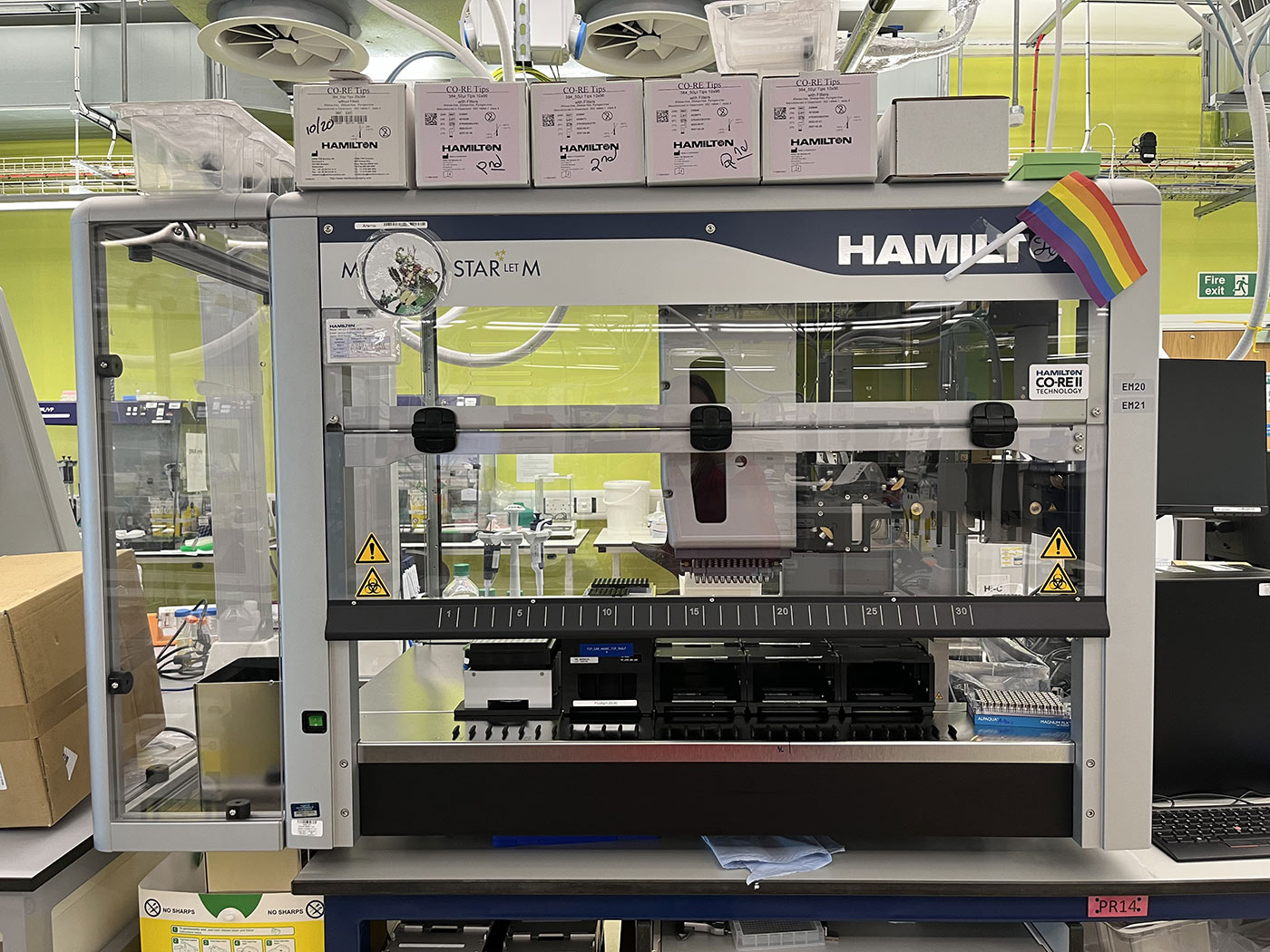
From a few at a time to many at once. Left: the Megaruptor - capable of shearing 8 samples of DNA at a time. Right: The Hamilton robot - able to shear many times more. Images credit: Shannon Gunn / Wellcome Sanger Institute.
What is a common misconception about automation?
I think for people who don’t have experience with automation, there can be some uncertainty about what it means in practice. But in reality, these systems still rely heavily on people – especially with a modular setup like ours. You need people to load samples, operate the instruments and make sure the data are accurate. While we’re not doing the pipetting by hand anymore, people remain central to the process. Automation simply allows us to process larger batches more quickly, reduce repetitive strain and human error, ensure consistent and reliable results, and ultimately do more science.
I think another misconception is that when I say I do some coding in my methods, people assume I’m a computer scientist – fluent in languages like Python or JavaScript. There are elements of that in various different automation platforms, but it isn't something that is absolutely necessary to create a method that you run. I can slightly read and edit this type of coding, but I wouldn’t be able to write something from scratch.

What are the most rewarding and challenging parts of your job?
I'd say the most rewarding bit was seeing the methods that I helped develop for the long read SPK3 process actually being used. Because I spent a lot of time, especially on the SPRI cleanups, getting that working. SPRI beads (Solid Phase Reversible Immobilisation) are used to purify and size-select DNA fragments. It’s a standard method in sequencing workflows to remove unwanted small fragments, salts and other impurities. Developing that method was particularly challenging just because of how much we had to create. It was so complex with loads of different if statements in there. We got the base of that method from Beckman, but it was then our job to go in and make it applicable for the samples that we were working with, which is what took the time. Seeing all that effort pay off – knowing the methods we developed were used to process over 1,500 samples and now form the basis for other workflows – made it incredibly rewarding.
What advice would you give to other people who might be interested in following a similar career?
I’d probably say that if you’re starting out in a lab, it’s important to ask questions and stay curious. Showing genuine interest, and once you begin to build some knowledge, demonstrating that you want to keep learning more, really helps. It’s also worth asking to shadow colleagues or volunteering to help with tasks whenever opportunities come up.
What do you like doing in your spare time?
I have recently got into Pokémon collecting. I always loved it as a kid; I grew up watching the cartoon and playing some of the games. I only recently got into card collecting and now I am hooked. I think it is mainly nostalgia. I have made a couple of new friends through that too.

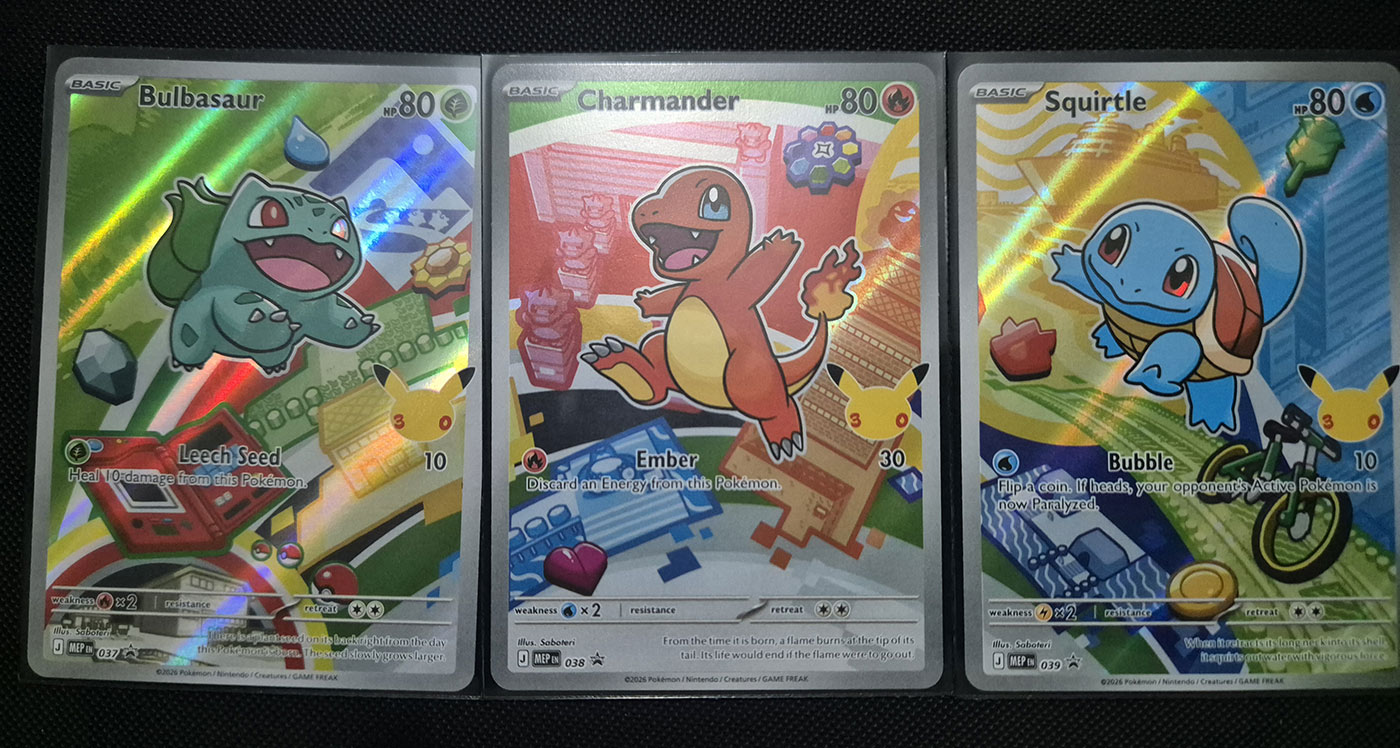

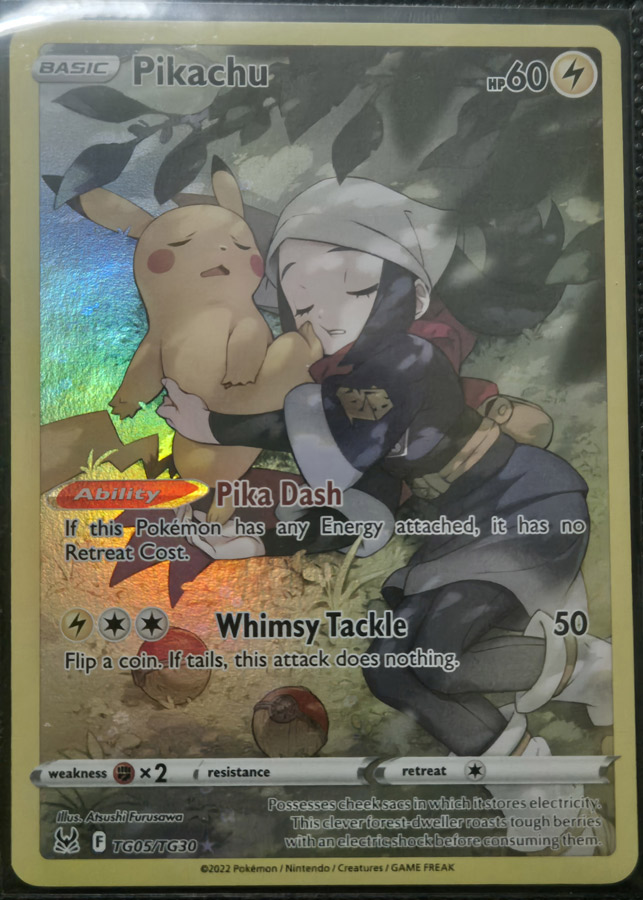

Some of Shelly's Pokémon card collection. Images credit: Shelly-Ann Coutts.
I also love pub quizzes. I usually go every week on a Tuesday. One of the local pubs near me does Speed Quizzing, so instead of writing down on a piece of paper, you use a tablet or a phone to answer the questions, which I quite enjoy because I like trying to be the quickest to answer.
I enjoy spending time with my friends and exploring new places with them, whether that is on holiday somewhere in Europe or exploring parts of the UK. Two of my favourite locations that I have been to are Denmark and Scotland!
I’m a big foodie – both my parents trained as chefs, so I grew up in a food-focused household and watching fine dining shows. I once celebrated my birthday at Tom Kerridge’s Bar & Grill in London, where his head chef at the time, Nick Beardshaw, served dishes he’d made on the BBC show Great British Menu. I had a dessert inspired by Banksy’s Girl with Balloon, and it was the best I’ve ever eaten. I love the creativity, skill and precision that goes into fine dining – it’s like a science.
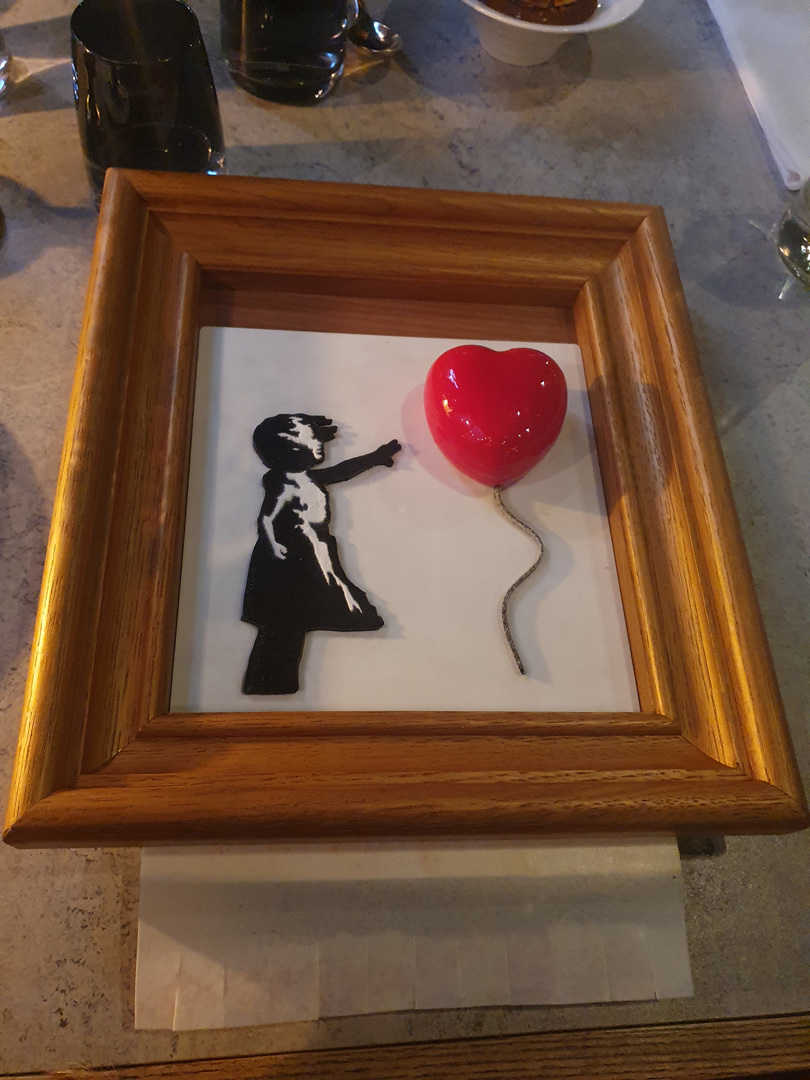
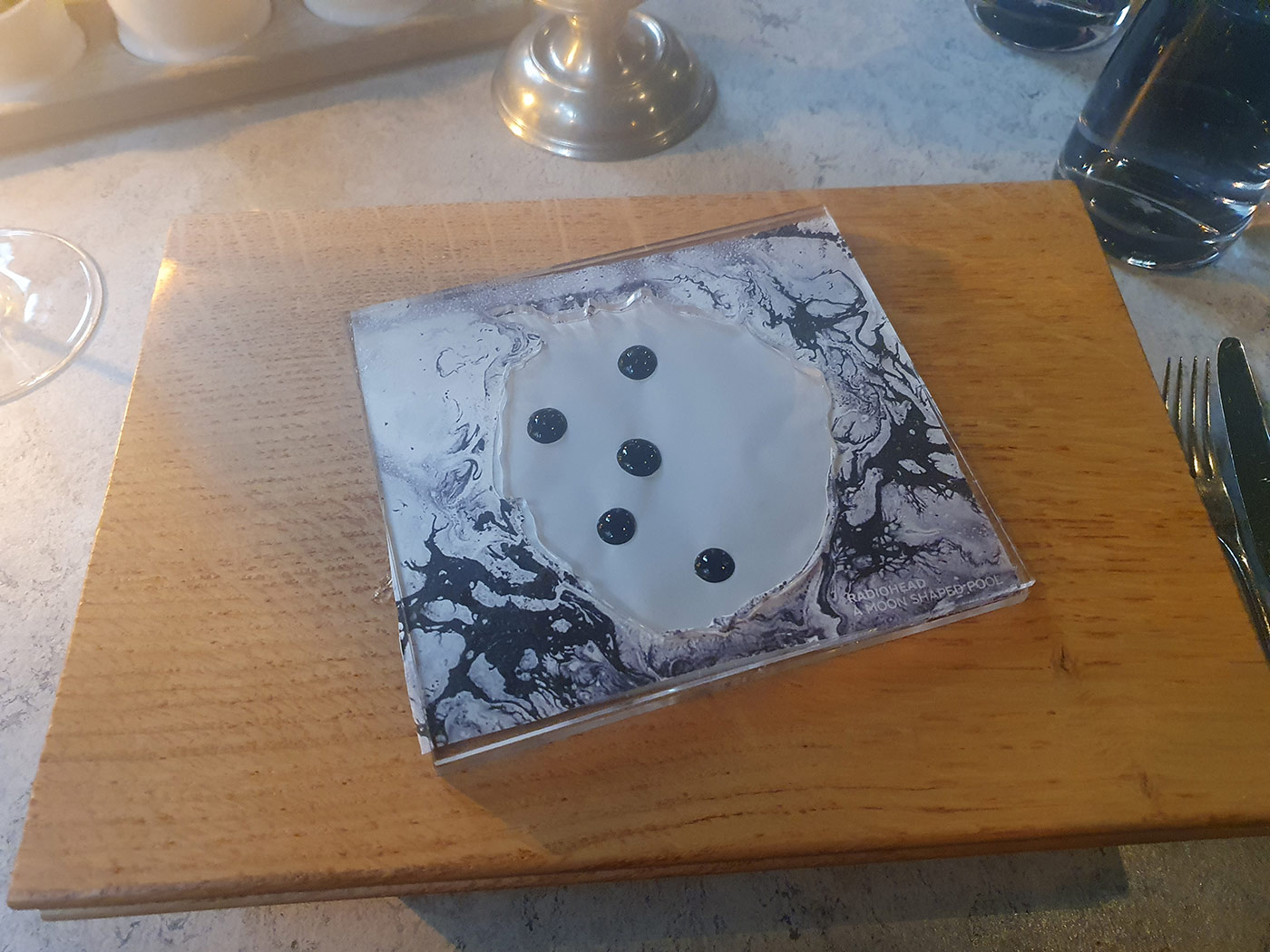
Dessert inspired by Banksy's Girl with Balloon and a starter inspired by the Radiohead album A moon shaped pool. Images credit: Shelly-Ann Coutts.


